Research Program

Leadership
Gail Wyatt, PhD
Principal Investigator
Alison Hamilton, PhD, MPH
Co-Investigator
Contact Info
Gail E. Wyatt Ph.D.
PI, SACERT Program
gwyatt@mednet.ucla.edu
Alison B. Hamilton, Ph.D., M.P.H.
MPI, SACERT Program
alisonh@ucla.edu
Amber Smith, MA
Senior Administrator (logistical questions)
ambersmith@mednet.ucla.edu
About
The Fogarty International-funded Sustainable Academic Capacity-Building of Excellence through Research and Training (SACERT) Program (D43TW012029) focuses on training predoctoral students in South Africa on chronic stress and non-communicable chronic mental disorders including substance abuse, depression, and posttraumatic stress disorder across the life course, with a focus on methods for conducting research on these topics. SACERT’s public health mission is to: 1) increase the number of well-trained South African researchers and mentors in chronic stress and non- communicable chronic mental health; 2) translate research findings into appropriate, acceptable, and feasible substance abuse and mental health treatment interventions and programs; and 3) facilitate the building of sustainable community clinical and research capacity.
The Sustainable Academic Capacity-Building of Excellence through Research and Training (SACERT) Program is an international collaboration between UCLA and several universities in South Africa. SACERT goals are to increase timely progression to completion of doctoral degree among pre-doctoral students, and to improve the educational and mentoring experiences of students at 16 participating institutions in South Africa. The focus of SACERT is chronic stress and non-communicable chronic mental disorders including substance abuse, depression, and posttraumatic stress disorder across the life course. We focus particularly on building capacity of scholars in the nursing, social work, occupational therapy, psychology, psychiatry, and public health fields to conduct translational mental health-related research via two pathways, Tracks A and B. We provide short-, medium-, and long-term research training which includes coursework and research training in an intensive 3-month in-residence training at UCLA and a long-term mentorship (Track A), as well as annual workshops in South Africa (Track B). The Specific Aims are to: 1) Implement a two-year multidisciplinary training program at UCLA and in South Africa for four pre-doctoral Scholars (“Track A,” who will be post- master’s degree, with approved dissertation proposals) per year (cumulative n=16) to: a) enhance their research skills in the areas of chronic stress and non-communicable chronic mental health disorders, b) support their research productivity during the two-year tenure, and c) strengthen their relationships with mentors; 2) Implement a training model involving annual virtual and/or in-person modular workshops for the Aim 1 Scholars (n=4/year) and mentors (n=4/year) and additional Scholars who will be master’s and predoctoral students (“Track B”; n=36/year for four years; cumulative n=144) and faculty (n=36/year), to: a) strengthen research and mentoring skills related to chronic stress and non-communicable chronic mental health disorders, b) build and sustain a supportive network of Scholars and mentors across universities, and c) disseminate the results of Scholars’ and mentors’ research related to chronic stress and non-communicable chronic mental health disorders; 3) Provide mentorship training to Scholars’ mentors (n~16/year) to: a) enrich the mentor-scholar dyad, b) increase capacity in South African university environments, and c) promote sustainability of our research mentorship model; and 4) Evaluate these training and mentorship efforts with regard to: a) time to degree, productivity related to publications and grant proposals; sustainability of training and mentoring (Track A) and b) knowledge and skills gained (short- and long-term), and satisfaction with educational and mentoring experiences (Tracks A & B).
Team
-

Gail Wyatt, Ph.D.
Principal Investigator -

Alison Hamilton, Ph.D., M.P.H.
MPI -

Norweeta Milburn, Ph.D.
Co-Investigator -
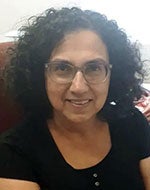
Sharon Kleintjes, Ph.D., M.Phil
-

Leickness Simbayi, M.Sc., D.Phil.
-

Mashudu Davhana-Maselesele, Ph.D.
-

Tamra Burns Loeb, Ph.D
-
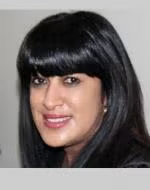
Soraya Seedat
Professor & Executive Head of Psychiatry, Stellenbosch University
Scholars
Cohort 1
-

Mukhethwa Londani, Ph.D. Candidate
Statistical Analyst, Research and Innovation, Tshwane University of Technology -

Asanda Boboyi, Ph.D. Candidate
Lecturer, Walter Sisulu University, Mthatha Campus -

Tshepang Modise
Lecturer, North West College of Nursing (NWCON) -

Thabo Arthur Phukubye, Ph.D. Candidate
Lecturer, Department of Nursing Science, University of Limpopo
Cohort 2
-
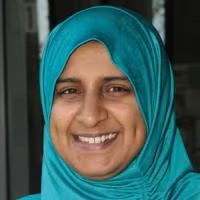
Munira Hoosain
Lecturer, Stellenbosch University -

Memory Muturiki, MD, MBA
-

Mabusela Anikie Motlatso, Ph.D., Candidate
Professional Nurse, Pietersburg Tertiary Hospital, Renal Unit -

Khuthala Sigovana, PhD Candidate Lecturer
Walter Sisulu University, Mthatha Campus
Cohort 3
-

Khalaeng Frans Thobane
Deputy Director National Department of Health South Africa Mental Health and Substance Abuse Directorate -

Munyadziwa Muimeleli, Ph.D Candidate
Professional Nurse at Kutama Sinthumule Correctional Centre -

Sumaya Gabriels
Lecturer in the Faculty of Health Sciences Division of Disability Studies (DSD) in the Department of Health and Rehabilitation Sciences at the University of Cape Town -

Asandile Mandlana
Lecturer Department of Social Work at the University of the Western Cape South Africa, Cape Town
Cohort 4
-

SACERT Cohort 4 Scholars
-

Philani Ndlovu, Ph.D. Candidate
-

Xolelwa Dyani, Ph.D. Candidate
-
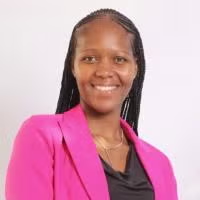
Katlego Magdeline Rantho, Ph.D., Candidate
-

Princess Shabangu, PhD Candidate
UCLA-SACERT Conference
FROM PREVENTION TO RECOVERY FOR MENTAL HEALTH DISORDERS ACROSS THE LIFESPAN:
BUILDING CAPACITY TO ADDRESS A GLOBAL CHALLENGE
12–14 May 2026
University of California Los Angeles (UCLA)
The NIH Fogarty-funded Sustainable Academic Capacity-Building of Excellence through Research and Training (SACERT) Program (D43TW012029) will convene US-based and international scholars on the UCLA campus in Los Angeles, CA to advance mental health prevention science and clinical practice globally. Participants will explore strategies to enhance access to care, integrate mental health interventions with broader public health initiatives, and develop sustainable solutions.
Key Objectives:
- Highlight global and regional trends in mental health prevalence and treatment gaps
- Share innovative approaches to prevention, early intervention, and recovery
- Foster international collaboration to strengthen research and clinical capacity
- Address cross-cutting challenges linking mental health to social and physical health outcomes
- Provide mentoring and networking opportunities across career stages
Conference Themes:
- Global (Trans-National) Comparative Research
- Social & Structural Determinants of Mental Health
- Contextualized Approaches to Mental Health, Trauma, and Violence
- Trauma, Intergenerational and Collective Trauma, PTSD, and Common Mental Disorders in High-Risk Contexts
- Implementation Science, Service Delivery, Task-Sharing, and Scaling Up Mental Health Interventions
- Prevention, Early Intervention, Life Course, and Resilience Frameworks
- Lived Experience, Service User, & Family Voices
- Digital Mental Health and Technological Innovation
- Comorbidity and Integrated Care
- Capacity Strengthening, Mentoring, and Research Leadership
Who Should Attend:
Researchers, clinicians, policy-makers, and students interested in mental health, prevention science, and global mental health initiatives
Registration Fee: None
Please email abstracts to: uclasacert2026@mednet.ucla.edu
Abstract Submission Deadline: 22 January 2026
For more information, contact Ms. Amber Smith at ambersmith@mednet.ucla.edu.
Conference Abstract Submission Guidelines
General Requirements for All Abstracts
- Abstracts must be submitted in English.
- Maximum word count: 300 words (excluding title, authors, and affiliations).
- Include:
- Title (concise and informative)
- Authors and Affiliations (indicate presenting author with an asterisk *)
- Background / Introduction (brief context)
- Objectives / Aims
- Methods (if applicable)
- Results / Key Findings (if available; for research-based submissions)
- Conclusions / Implications
- Abstracts must clearly align with conference themes.
- Tables, figures, and references are generally not permitted in the abstract text.
1. Oral Presentations
- Focus on research studies or clinical projects.
- Presenting author must attend the session.
- Include a clear description of study design, methods, results, and implications.
- Duration: 12–15 minutes, followed by Q&A.
2. Poster Presentations
- Ideal for early-stage or exploratory research.
- Include research questions, methods, preliminary findings, and conclusions.
- Posters should be visually clear, concise, and self-explanatory.
- Presenting author should be available during poster sessions for discussion.
3. Symposia
- Symposia consist of 3–4 related presentations under a common theme.
- One person serves as chair/moderator, who must be named in the abstract.
- Include in your submission:
- Symposium title
- Chair name and affiliation
- Brief overview / rationale (100–150 words) describing the symposium’s focus and significance
- Individual abstracts for each presentation (max 300 words each), including title, authors, and objectives
- Optional planned discussion / Q&A structure
4. Panel Discussions
- Panels feature experts discussing a topic or controversy in an interactive format.
- Include in your submission:
- Panel title
- Chair/moderator name and affiliation
- Brief description (150–200 words) outlining the topic, relevance, and key discussion points
- Panelist names, affiliations, and expertise
- Optional planned audience interaction or Q&A format